Tuesday, June 11, 2013

No Man's Land

After a long week of work and interviews (two things I will be posting about in the near future), Colleen, Jenn, Brad, Katie (a PCV), and I headed for Sani Pass.  Sani Pass is the main road connecting the west end of Mokhotlong District in Lesotho to the east end of Kwa-ZuluNatal District in South Africa.  It was originally developed as a donkey path in 1913 to connect Mokhotlong to Underberg, South Africa, by way of the Drakensburg escarpment.  The Drankensburg escarpment is a steep slope created by erosion and falling rock that connects the lowlands of South Africa with the 9,429 foot elevation of the Lesotho border.  The road to Sani and the pass itself is the typical mixture of dirt and rock that I’ve seen on almost every road in Lesotho.  The really interesting aspect of the pass is that it is sort of a no-man’s land, an 8km stretch of road owned neither by South Africa nor Lesotho.

Our plan was to reach the top of the pass at the Lesotho border and hike around Saturday morning before heading down the pass to Underberg for the night.  It was a great plan.  We left on time, Brad drove (probably too) fast through the winding mountain roads, and we reached the sign for Sani Pass in just about two hours.  Of course, we had to get out of the car and take pictures at the sign!
Unfortunately, our picture taking was met with hurricane-force winds that made us wonder whether hiking up there was really a good idea.  As we approached the edge of the pass, the wind refused to calm and we had no choice but to head to Sani Lodge and talk about a game plan.  Did I mention that Sani Lodge is home to the highest pub in Africa?  Perfect place to hide out from the wind and cold!  After drinking some hot chocolate, watching a hiker (who had poles for support) get knocked over by the wind, breaking a car door that got blown open a bit too far, and Jenn’s glasses being blown off her face and into the Sani Pass abyss, we decided to drive down the pass and relax in Underberg for the day.  Hiking would be put off until Sunday.


I was expecting Underberg to be a bustling town with lots of things to do.  Boy, was I wrong!  Underberg was quaint, with rolling hills of farms, paved roads, and only two good restaurants to eat in (as we were told by a nice South African woman).  Amusingly, we spent basically the entire day eating at these two restaurants!  We dropped our bags off at the Sani Backpackers, a hostel where we were spending the night, and our next stop was for lunch at a cute cafĂ© called The Lemon Tree.  After the Lemon Tree we stopped at Brad's favorite place called Pucketty Farms (I was bummed to find out this wasn't an animal farm).  Pucketty Farms was completely empty, in fact paying for anything you buy there is done on the honors system.  You simply write down what you bought and put the money in a small box...weird!  We did find some ice cream for the first time since we've been here, so obviously I jumped on the opportunity to have some of that!  After Pucketty, we drove around for bit, saw a beautiful sunset, and found ourselves at The Old Trout Hatchery.

So much jam...and paying via the honors system

Colleen and I enjoying some greatly missed ice cream!

When we walked into the Hatchery we found a group of South Africans drinking beer, huddled around a TV watching rugby.  The South Africa Springbocks vs. Italia!  Turns out the Springbocks are one of the highest ranked teams in the world, so Italy basically stood no chance (at least according to Robby the bartender).  It was an exciting experience, though, because rugby is such a huge part of South African culture and we were diving right into it!  After a couple drinks (because you can’t watch rugby without drinking some beer, also according to Robby), we saw South Africa win, ate dinner, and walked out to the car.  Side note: I found it very odd that the Old Trout Hatchery didn’t actually have any trout on the menu…

Sunset pictures!

The Lemon Tree...and watching rugby at The Old Hatchery

Before we reached the car, however, we were met by Patricia Lambie.  Patricia is a sheep named after Patrick Lambie, a famous South African rugby player.  Colleen has been waiting for the past 5 weeks to hold a lamb, and here was her chance!  We seized the opportunity to hold the sheep and take tons of pictures.  I was really surprised how soft Lambie’s wool was!  I think we scared her a bit considering she ran and hid behind a bunch of chairs as soon as she escaped our arms, but we just couldn’t resist the idea of hanging out with a sheep.
Now introducing.....Patricia Lambie!

Morning view from the hostel.
 Sunday morning Jenn left the backpackers super early to make a 13 mile hike from Underberg to the top of Sani Pass.  The rest of us went back to the Lemon Tree for breakfast and enjoyed a crazy, but yummy meal of French toast layered with Canadian bacon mozzarella cheese, and syrup.  For all of the Italian’s at home, mozz and syrup was actually not as disgusting as it sounds…I was very skeptical at first!

We soon left to go back up the pass because the skies were getting dark and we wanted to make sure Jenn was okay.  We crossed the South African border into the pass and found Jenn a mile or two up the road.  Even though it was flurrying, she wanted to keep hiking.  I had been thinking all night about how cool it would be to hike up the pass, so I decided to hop out of the car and hike up the rest with Jenn.  It took us a little more than an hour, it was steep and my butt was sore on Monday, but it was so worth it!  The views were beautiful and by the time we reached the top it was snowing. Yes, snow in Africa!  I felt so accomplished and was pumped to finally reach the top; I'd hiked from 7000ft above sea level to 9000ft above sea level.  We rushed back to TTL to avoid getting stuck in the snow, but by the time we got back here it was a beautiful sunny day.

Enjoy these pics from my hike up Sani Pass!


I'm Queen of the world!

The winding road ahead

The winding road below


A frozen waterfall

Go, Jen, go!


We made it!

It’s been freezing at TTL the past few days, so I’ll probably spend a lot of time indoors sitting next to the heater writing blog posts, so stay tuned! Have a great day!

Thursday, June 6, 2013

Baby, baby, baby oooh!


Welcome to TTL's Safehome!

Saturday was the 9th birthday of Touching Tiny Lives, and it also marked my first visit to the safehome.  Words cannot describe my excitement to get to hold such adorable little children!  When you first walk into the safehome from the volunteer sleeping quarters, you enter a playroom scattered with toys, bom’e (boh-may…the Basotho women who take care of the children), and babies galore!  Most of the children are under the age of 2, so at any moment in the safehome there’s a good mixture of sleeping babies, crying babies, and crawling babies.


T during his time in the TTL safehome.
His hair finally grew in by the time I saw him!
The first child I met in the safehome was little T (I won’t use any names because of TTL’s Child Protection Policy), a boy less than two years old and quite possibly the cutest child I have ever seen.  I was a bit surprised when T came right up to me to play considering there are rumors that some babies are afraid of newcomers, especially ones with pale skin.  Within a matter of minutes T and I were best buds; I fell in love with him (don’t tell my boyfriend!) and contemplated stealing him to bring home with me.  He just had so much energy, a big smile, and a little chuckle that lit up the room.  The second day I entered the safe home T crawled to me faster than I’ve seen any child move, grabbed my hands, and leaned his head back…our signal from the day before to lift him over my head like an airplane.  I couldn’t believe he remembered!  I also thought it was very funny how little T liked to rub my hair between his fingers as if feeling something new for the first time (it was cute until he started pulling on it!).  I decided to read up a bit on T in order to learn what he was like when he entered the safehome.  I found some of T’s story in a TTL blog post written by a med school volunteer who stayed here in March.  Her description of him as a limp, skinny, almost lifeless child shocked me.  This was definitely not the T I was hanging out with now!  I guess it just goes to show the amazing things that can be done for malnourished children with the proper care and feeding habits here at TTL!  T went home to his family this past Monday…I was very sad to see him go (a selfish feeling, I know).  The staff say he was very happy to see his grandparents again when they dropped him off out in the villages, and I’m hoping to see him still happy and healthy when we stop by his new home on outreach in the coming weeks.

There is another little boy in the safehome who is actually a bit of an anomaly for TTL.  As I mentioned in other posts, TTL’s target population is children under 5 years old.  This boy, I will call him “M,” has a sweet smile, is a skinny little thing, and is 8 years old.  He also walks with a limp because he has the worst scoliosis (crooked spine) I have ever seen.  M’s condition is still a bit unclear because his Bukana (the small booklet every person in Lesotho has filled with medical records) is missing details from several years of his life.  According to M’s grandmother, he was born a healthy child and his spine didn’t become contorted until recently.  This led the physicians here to believe that M had a serious case of spinal tuberculosis. 

Tuberculosis (TB) is a bacterium spread through aerosols, aka the droplets released from coughing, sneezing, talking, and laughing.  The majority of people infected with TB (95%) never actually show symptoms because their body is able to “wall” it off.  Since TB is generally a pulmonary disease, those who do show clinical signs of disease have a consistent cough that draws up sputum from the lungs. Tuberculosis is highly prevalent in Lesotho, with approximately 696 per 100,000 persons infected with the bacteria.  This makes Lesotho the country with the 3rd highest prevalence rate in the world.  Because HIV lowers immune system functioning by attacking white blood cells, TB and HIV co-infection is also very prevalent in developing countries and is a major public health concern here (64% of TB cases are estimated to be co-infected with HIV in Lesotho).

TB educational sticker I found on a motorcycle in Mokhotlong.
The good news is that TB is treatable.  The bad news…the treatment is a pill a day for 6-9 months and missing one dose can destroy any immunity your body has developed.  The even worse news…as people have missed doses over time, certain strains of the bacteria have become resistant to the antibiotics we do have available.  This is called Multi-drug Resistant Tuberculosis, or MDR-TB.  Furthermore, if left untreated because of missed doses or lack of access to the full treatment regimen, TB can spread to the bones, brain, liver, kidneys, and heart.  Extrapulmonary TB, also called Pott's disease, can be fatal.  Since M’s family did not have access to the proper treatment for his TB, and in fact may not have known he was infected, M is now left with the aftermath of a serious case of spinal TB.  Luckily, TTL has access to the proper antibiotic regimen for M so he has been receiving treatment since he first arrived here.  Unfortunately, though, multiple surgeries are be needed to fix his scoliosis, along with much fundraising and logistics planning before this even becomes an option for M.  I really hope we can do something to help him in the near future, I need my little buddy to keep teaching me Sesotho words!

The body of the malnourished twin girl.  Heartbreaking.
On another note, the birthday of TTL was met with 3 new (very malnourished) arrivals to the safehome.  One is a four-month old girl, weighing just about 6.6 lbs.  She is an orphan in the care of family members who say she lost a lot of weight due to several bouts of serious diarrhea.  In the developing world, diarrheal disease is the leading cause of death among children due to dehydration.  The other two arrivals were six-week old twins, a boy and a girl, who were the most emaciated babies I’ve ever seen.  The baby boy weighed 2.8kg and the baby girl weighed 2.2kg, that’s about 6 lbs and just less than 5 lbs respectively.  The mother of these twins wasn’t producing enough milk for both of them and didn’t have access to formula, so she was mixed feeding them with porridge.  Since babies that young cannot digest porridge properly, these two twins were not receiving any of its nutritional benefits.  When I held both of them for the first time, they were swaddled in huge blankets for warmth.  I’m pretty sure the blankets weighed more than they did.  The boy took to bottle-feeding pretty quickly and is doing well so far.  The girl, however, did not.  On Monday I helped the TTL fellow, Jenn, put a nasal feeding tube in the baby girl.  She could barely exclaim her discomfort with it; she hardly has enough energy to let out more than a soft whimper.  When you pinch her skin it also stays dented, a sure sign of dehydration.  Jenn has been giving her oral rehydration salts (ORS – a mix of water and salts usually used to rehydrate children with serious diarrheal attacks) through the feeding tube each day in order to fix this problem.  Our little twin girl has been struggling more than we’d hoped, but the TTL staff is doing everything they can to make sure she survives this tough start to life.

Holding the twin girl just after her arrival to the safehome.
Barely opening her eyes.

Putting in the feeding tube.  Look how tiny her body is
compared to my hand!
Tiny, tiny fingers.  Her wrist is smaller than the width of two adult fingers.
There are so many adorable children in the safehome…I could probably talk about them all day!  There’s a six-month-old baby girl who's growth is so stunted I thought she was a newborn.  There are two little boys on antiretroviral therapy because they are HIV positive.  But then there are also the children who look healthier than ever thanks to proper medicines and nutrition offered by TTL.  My overwhelming feeling of sadness when I see the new arrivals and the sickest children is soon met by a feeling of encouragement when I see kids like T headed back to their families, happy and healthy.  When I go in to help out at dinner everyday, I am excited to take part in improving the health and nutrition of each child here.  I can’t wait to watch them grow and learn over the next 5 weeks…the safehome really is a magical place!

Don't you love me?!
(His nickname is Makoena because his cheeks look filled with fat cakes!)

Just chillin'

Tuesday, June 4, 2013

Makoenas for everyone!

On Fridays everyone at TTL gets off of work at 3:30…just in time for happy hour at the bar in Mokhotlong Hotel (picture one of the one-story motels you see at home).  No better way to kick off the weekend!  We headed to the “private” bar at Mokhotlong Hotel Friday afternoon and got to spend some time with TTL safehome staff and outreach workers in a more relaxed setting.  It was really fun to talk to them about life in Lesotho outside of work and learn what their family life was like.  I found it quite bizarre that the hotel had two bars.  We were in the Private Bar towards the back of the hotel because we are apparently of a certain higher class, but mostly because we had women in our group.  The public bar is located near the front of the hotel and it’s highly frowned upon for women to be seen in there.  I really wanted to go in just to see what it was like, but I didn’t want to upset the cultural norm.

Ellen, Will, and some of TTL's Outreach Crew!

Mokhotlong Hotel is also the only place in town where you can get pizza.  I was pretty skeptical about the idea of pizza in Lesotho, but it actually turned out to be pretty good!  We had pizza with green peppers, onions, and either chicken or beef.  It’s no NY slice, but I was definitely satisfied after the meal.  The only down side is it takes about 45 minutes just to get one pizza (lesson learned: order well in advance here!).

Pizza and Lesotho Beer

We also met a bunch of Peace Corps Volunteers (PCVs as we like to call them) at the Mokhotlong Hotel Friday night.  I was alarmed when a group of white kids not much older than myself walked into the bar…we don’t see many other light skinned people hanging out in Mokhotlong!  The PCVs were really cool people and I enjoyed hearing what their life was like in Lesotho.  Most of them live out in the small villages that we visit on outreach.  They inhabit the little rondavels just like the locals, with no running water or electricity.  For light they have to use candles and for water they must go to the communal village tap.  Almost all of them are here to teach Math or Science in the local schools.

School here is similar to home, with elementary (or primary) and high school.  Lesotho even has its own University in Maseru.  Interestingly, school is taught almost entirely in English  here.  It’s no wonder I can converse with so many people!  The scary part of school in Lesotho is that a large percentage of each class fails and must repeat the entire year.  One PCV told me that you need to average a 50% in all of your classes combined to pass, but that’s apparently very difficult, especially out in the remote villages.  She said that it took her a long time to realize kids getting a 40% on her tests were doing a good job, which is odd considering in the U.S. there’s almost nobody who completely fails an entire year of school.  It makes me wonder how many Basotho actually receive an education through high school…

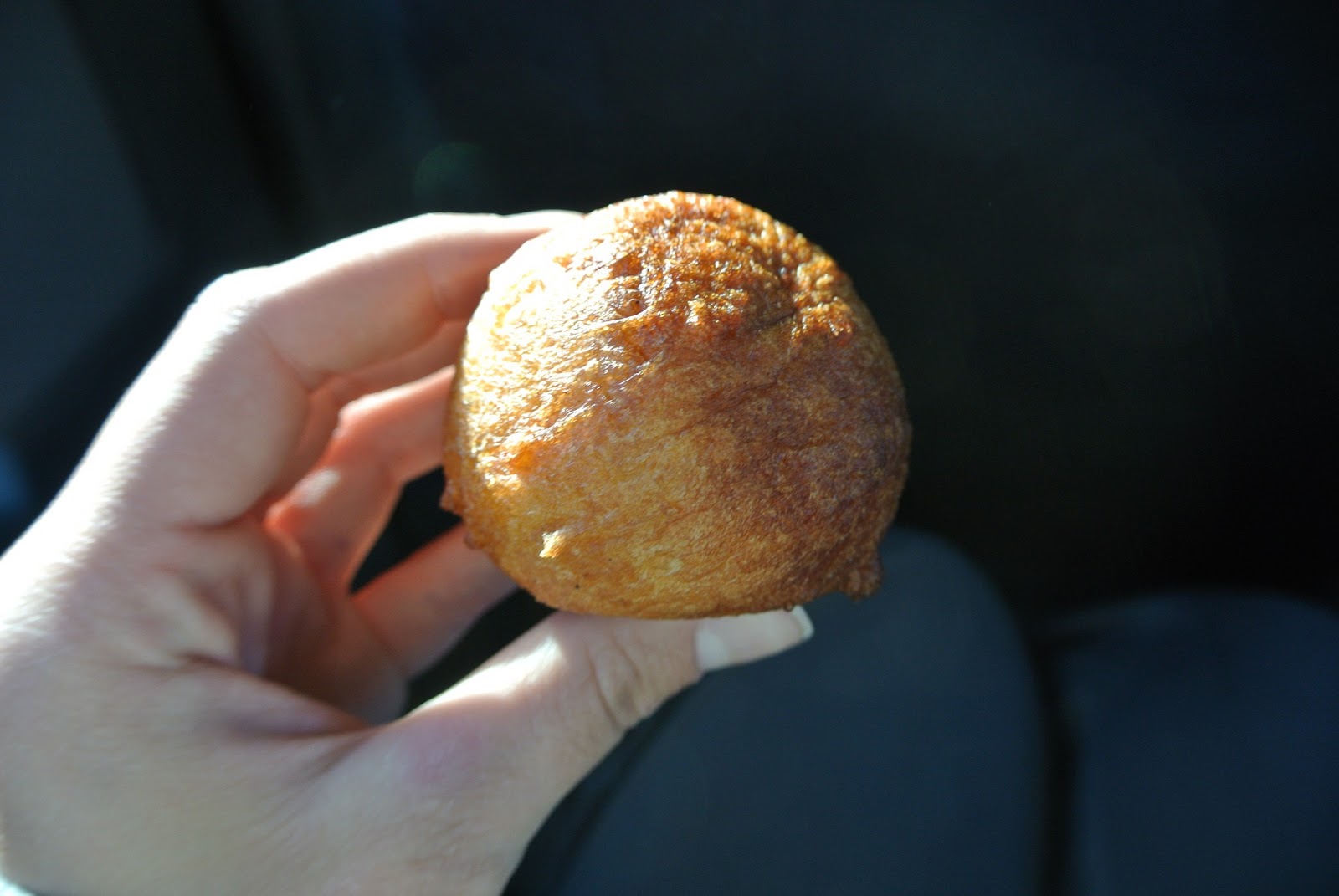
Saturday and Sunday are pretty relaxing days around TTL and in Mokhotlong.  Saturday the weather was amazing.  I spent most of the day outside because I wanted to soak in the warm weather before the dead of winter really hits!  In the afternoon we walked into the main part of town where the streets are lined with small tin huts that sell food, clothes, and other miscellaneous items.  Brad, one of the TTL fellows, found what we now call the best makoena (sounds like moh-que-nia) shop in town.  Makoena’s are basically a ball of dough that is fried on the outside and tastes like heaven, especially when you put brown cinnamon sugar on it!  In English they are called “fat cakes” and you can get them homemade almost anywhere in Lesotho.  After 6 adults and 1 child shared about 16 of them outside the shop, we began to give them out to TTL staff we found walking along the road.  These little fat cakes provided us with a very entertaining afternoon!

Makoenas!

Dipping the makoena in brown cinnamon sugar...yumm!

About to eat my first makoena!

Just before sunset Brad, Colleen (the other MSGH student here), Ellen (my advisor), Will (Ellen’s husband), and I headed up the mountain behind TTL for a hike.  Hiking on that mountain is a lot of fun because there is no trail so you just make your own path.  I was very sore after my first hike here!  When we got to a ridge that overlooks all of Mokhotlong we took the opportunity to do what every good hiker should…jumping pics!  We had such a blast timing our cameras up to take silly pictures of us jumping as high as we could without breaking our ankles on the rocks below us.  It was definitely the perfect excuse for advisor/advisee bonding.

Sunset over Mokhotlong from the mountain behind TTL

Colleen, Ellen, and I jumping!
MSGH Students Rock!
The hiking crew! (Me, Ellen, Brad, Colleen, Will)

My advisor and her husband are both ND grads and played on the Ultimate Frisbee team while at school.  Ellen then went to Michigan to get a PhD in Anthropology and Sociology where she wrote her long and awesome dissertation on health in Lesotho.  While she lived here doing PhD research for one year, her husband taught at Mokhotlong High School.  They now have two adorable children who came along with them on this past trip (they left to head back home on Sunday).  Ellen is now doing a Post Doc year at Brown and she came back to Lesotho to continue research for future publications.

The beginning of this week has been quite the ride so far, so stay tuned for some new posts…especially the next one about the TTL’s safehome babies!!

Saturday, June 1, 2013

"Yes, she asks a lot of questions!" (Outreach Day 1)

I woke up early on my first day in Lesotho to head out with one of TTL’s outreach teams in order to observe how the whole outreach process works.  If you ask me now how the day went, I would tell you it was absolutely amazing, but to be honest, I was beyond nervous while getting ready that morning.  I hadn’t even been at TTL for 12 hours and I was just being thrown into the thick of things!  Actually, I was being thrown into a car with two male outreach workers I’d just met and would be spending the next 7 hours with, just the three of us.  We were headed out to visit two of TTL’s clients in Linakaneng (pronounced “dee-na kee-nayng”), a community of villages 2.5 hours outside of Mokhotlong with a population of approximately 4,500 people.  The outreach workers were actually very friendly and taught me a lot on this trip; I will refer to them here as “R” and “T” since I didn’t ask permission to use their names.

Our first stop along the way was when we got pulled over for a police check.  Apparently they have a lot of those here along the main roads, especially in the morning.  I couldn’t understand exactly what the cop was saying, but judging by how quickly R and T put on their seatbelts, I’m guessing that was the topic of conversation.  We got away with a warning, which I was happy about because I learned that they fine you right on the spot here in Lesotho.  I think I just found the one thing about the American police ticketing system that I like…

Almost immediately we were driving along a dirt road again, and this time by dirt road I mean rocks with some dirt filling in the spaces.  Anyone with motion sickness would definitely not have enjoyed this ride.  If I thought Jenn did well driving on Lesotho roads, then R must be the “sensei” of all Lesotho drivers.  Some parts of the road were smoother than others, but all I can say is thank God for four-wheel drive!  The most terrifying moments on this road were when I saw another truck or taxi approaching.  Luckily, R handled passing them with ease.  The “taxis” that passed us quite often are actually big white vans stuffed with more people than should really fit inside.  Since the large majority of people in the villages don’t have access to cars, a taxi is the only way for them to get to the main town of Mokhotlong.  T told me there used to be large buses that would transport people to and from Mokhotlong, but this was only possible when the dirt roads were new.  This long, winding road through the mountains was actually very well-planned at the time it was built, but rain and falling rocks destroyed the road over time leaving behind the bumpy trail we were traveling.

White taxi approaching us on the road.


The road (or should I say rocks) ahead!
Can you pick out the path of the road here?
A glimpse of the rocky road winding through the mountains.  The slopes are steeper than they look!

About two hours into our trip we reached the first outreach destination, which was a small rondaval (what the traditional circular homes with thatched roofs are called) situated on a pretty steep slope.  When we entered the home, I was immediately invited to sit down at the small table in the center of the circular room.  For homes that do have tables, it is a cultural courtesy to invite the guest to sit down at the best spot in the home, the Basotho insist upon it.  I took my seat as directed and began to take in the scene around me.  The walls inside were a beautiful teal blue.  There was one bed, a dresser for clothes, a small table with a few chairs, one light, and a dresser that served as kitchen storage.  Surprisingly, this rondaval had electricity whereas most of them must use candles for light.  The home was humble, but very tidy…maybe that’s just because they knew visitors were coming.  In talking to other experienced volunteers at TTL, this rondaval was equipped with many more amenities than most others (for example, most of them have no real furniture).

First home we visited on outreach.  Very remote!

The client we were visiting was a baby girl cared for by her grandmother.  R told me that the girl’s mother passed away when the baby was just 1 day old.  When I asked R her cause of death he said they were unsure, but they do know that she was on ART treatment for HIV/AIDS and the grandmother said something about a tetanus shot.  I also asked R if the baby was on ARVs since her mother was HIV positive and he said they were still waiting to get the test results back.  I immediately said a prayer that the test comes back negative.  I also learned that this baby had stayed in TTL’s safe home for 5 months after birth.  What a rough start to life for this adorable little girl.  Outreach did their thing for about 20 minutes while I sat and watched, then we were off to the second stop.

At the second rondaval we were greeted by an elderly man, two elderly women (in very worn out sneakers), and the one of cutest little boys I’ve ever seen.  This boy is also taken care of by his grandmother.  My advisor told me recently that many of the women here have children out of wedlock and eventually the father is not at all in the picture.  I guess that fact and the high prevalence of HIV/AIDS are the main reasons TTL sees so many orphaned children.  Outreach did their duties outside of the home at this site, so of course I took a bunch of pictures!

So the first thing the outreach worker does is look at the child’s Bukana.  The Bukana is essentially the medical record book of each person here.  Every time a patient sees a doctor or nurse, he or she writes the diagnosis, prognosis, and treatment recommendations in this book.  All vital signs and measurements are also recorded in it.  As you might be able to guess, the Bukana is sacred to the job of TTL’s outreach workers.  After outreach looks at the Bukana and asks all the necessary questions of the caregiver, they record any new information on special TTL forms.  They then weigh the child on a hanging scale (both children we saw freaked out during this part), measure the length of the child on a human-sized ruler, and take the child’s MUAC.  For the non-global health students reading this, MUAC stands for Middle-Upper-Arm Circumference, which is used as a measure of malnourishment.  T and R gave one of the elderly women money, too, because she helps transport the mother from a village even farther away to these TTL outreach visits.

"T" weighing the young boy.
"T" measuring the length of the baby.
Taking the MUAC.  The red area means sever malnourishment...

...but we were happy to see this boy in the green!  Nutritionally in the clear!
Bag of nutritional supplements for the family, with the yellow Bukana sitting inside.
I really enjoyed this second visit because I saw a lot of little things that were exciting.  First, I noticed that just as the first baby we saw this little boy was wearing a string of beads around his waist.  I have yet to learn what the beads mean, but they are obviously something traditional in Basotho culture.  I also enjoyed the solar panels connected to an old battery sitting outside the rondaval.  T told me this was used for radio.  We also had the car radio on during this outreach visit since we were outside and I really enjoyed hearing one of the elderly women sing along with the traditional music resonating from the car speakers.

Solar panel connected to the battery sitting outside the second home.

Eventually we headed back to TTL, but not before passing amazing views of the rolling "Mountain Kingdom".  By the time we got back all of my clothes, my backpack, my notebook, and my face were covered in dust from the dirt roads.  I asked R and T probably a hundred questions during this entire trip, so this post could go on and on and on (as if it wasn’t long enough already).  Amusingly, I fulfilled the stereotypical white person character by asking so many questions, as part of the Basotho culture is to not ask many questions about anything.  I was pretty positive I annoyed R a bit with all my questions, and I got affirmation when he told a TTL fellow, "Yes, she asks a LOT of questions."  You can take the girl out of the west, but I guess you can’t really take the west out of the girl!  I figure telling you about outreach itself now and then putting shorter posts about all of the other things I witnessed and learned about will probably keep you from getting bored.  Outreach was an absolutely incredible experience, one I just had to share details about because I wish I could bring everyone with me to experience it all!  I hope this gave you a good taste of a major piece of TTL’s work and the setting in which I will be doing my research.  Talk to you soon!

Views from the ride through Linakenang.  Enjoy!